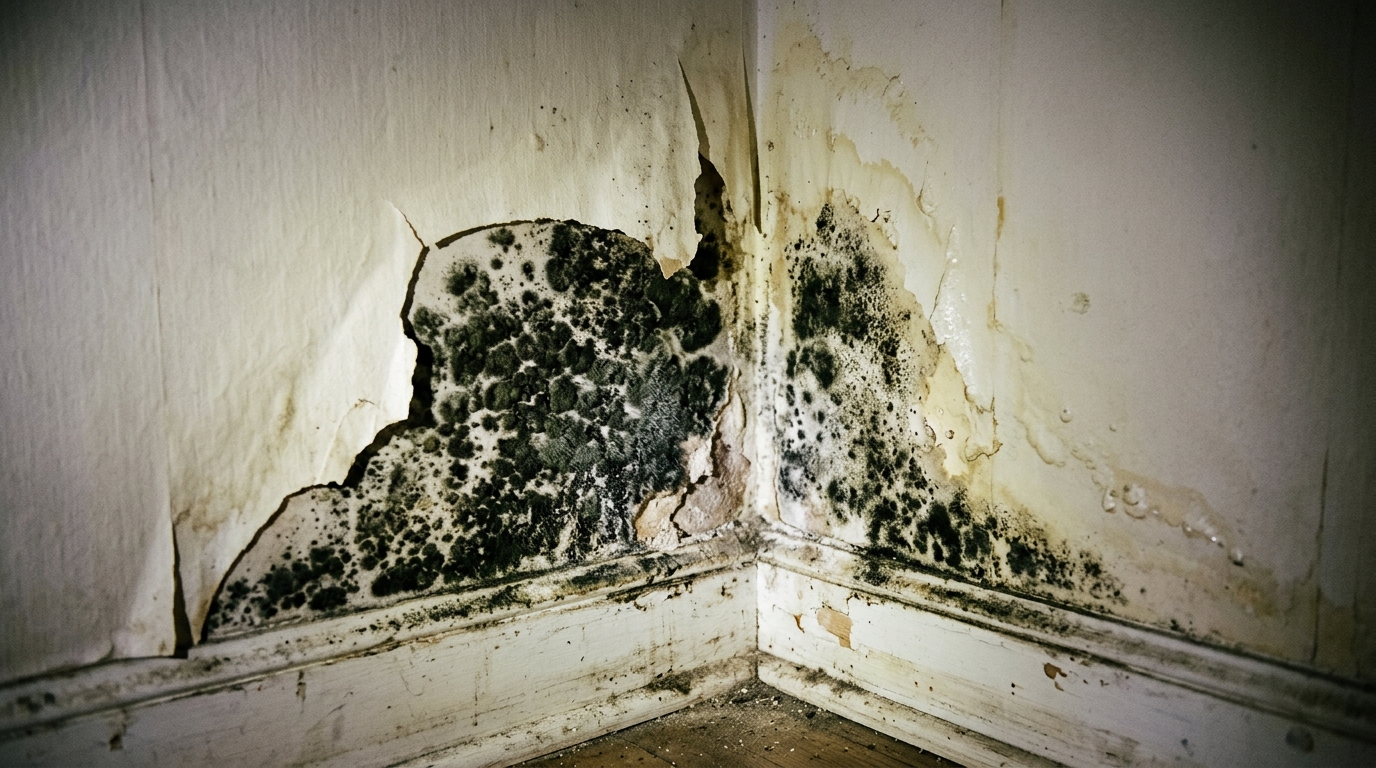
Mold is an opportunistic organism that thrives in the shadows. It requires only three ingredients to colonize a home: moisture, a food source (like drywall or wood), and stagnant air. When a property experiences an unaddressed plumbing leak, roof failure, or severe flood, mold can take hold in as little as 24 to 48 hours. When that growth transforms into toxic strains—such as Stachybotrys chartarum (commonly known as black mold)—it stops being a simple cosmetic issue and becomes a severe environmental hazard that compromises the respiratory health of anyone inside.
For property owners in North Texas and Southwest Oklahoma, discovering a massive mold outbreak can be completely paralyzing. Remediation is notoriously complex, requiring specialized biological protocols, air containment zones, and extensive demolition.
When facing the steep costs of environmental cleanup, many homeowners decide to sell the property on the retail market to escape the burden. However, trying to sell a home with active toxic mold through traditional channels usually hits a bureaucratic and financial wall. Let’s look at the realities of listing a mold-compromised home and explore why a direct cash sale is often the most practical, stress-free path forward.
The Hidden Roadblocks of the Traditional Retail Market
When you list a property with a real estate agent on the Multiple Listing Service (MLS), your target audience consists of retail buyers who rely on traditional mortgage financing. If your property has a known mold infestation, the conventional transaction pipeline breaks down due to three major obstacles:
1. The Legal Disclosure and Inspection Traps
Every traditional real estate transaction involves a rigorous third-party home inspection. If an inspector spots visible mold or detects a strong, musty odor, they will flag it immediately and mandate a specialized air-quality mold test.
Once a professional laboratory report confirms high levels of toxic spores, that data must legally be disclosed to every future buyer. Furthermore, if you filed an insurance claim for the underlying water damage, that event is logged in the national CLUE database, making it incredibly difficult for a retail buyer to secure a standard homeowner’s insurance policy on the property.
2. The Mortgage Financing Blackout
This is the single largest hurdle on the open market. Traditional lenders—including those backing conventional bank loans, FHA guidelines, and VA programs—operate under strict minimum property standards.
Banks will flatly refuse to fund a mortgage on a home with an active toxic mold outbreak or failed air-quality clearance. Underwriters view mold as an immediate health and safety hazard. They will mandate that a certified remediation company completely clear the spore count and provide a formal clearance certificate before closing. If you do not have thousands of dollars in liquid savings to pay for environmental contractors upfront, your property cannot be sold to a retail buyer.
3. The Destructive Chaos of Remediation
Remediation is an invasive process. Certified crews must seal off sections of the home with heavy plastic sheeting, run industrial air scrubbers, and physically rip out infested drywall, insulation, carpeting, and cabinetry.
What begins as an expensive environmental cleanup frequently triggers a secondary wave of costly interior reconstruction. You are forced to hire a second set of contractors to patch drywall, install new cabinets, and repaint the home just to make it presentable to retail buyers again.
Real-World Case Studies: Listing vs. A Direct Cash Sale
To see how a direct cash sale can rescue your equity from an environmental hazard, let’s examine two contrasting real-world outcomes.
Case Study A: The Traditional Listing Remediation Trap (The DFW Metroplex)
A homeowner in the Dallas/Fort Worth area had a slow, hidden plumbing leak inside a guest bathroom wall. By the time it was discovered, black mold had spread across the entire wall cavity and into the master closet. An agent convinced them to list it on the MLS to find a buyer willing to do the cleanup work.
- Month 1–2: The home receives a few tours, but buyers are terrified by the musty odor and the visible mold patches. A buyer finally makes a lower offer, and a contract is signed.
- Month 3: The buyer’s mortgage lender reviews the home inspection and denies the loan until a certified mold remediation company provides an air clearance certificate. The seller calls environmental crews and receives an estimate of $14,000 for full containment, demolition, and clearance testing.
- Month 4: The homeowner drains their savings to pay for the remediation out of pocket. However, when the drywall is removed, crews find structural wood rot that requires another $5,000 in carpentry work. The delays push past the buyer’s mortgage rate-lock window, and the buyer walks away from the deal entirely.
- Month 6: The house sits vacant while the owner pays continuous mortgage and utility bills, stuck with an unfinished interior and significantly diminished equity.
Case Study B: The Swift Cash Resolution (Lawton, Oklahoma)
An out-of-state individual inherited a vacant home in Lawton, Oklahoma, that had suffered roof damage from a severe storm, leading to extensive mold growth across the ceilings and walls. The heir lacked the time or desire to wear hazmat gear, manage environmental crews, or fight with mortgage banks from afar.
- Day 1: The heir contacts an established direct cash home buyer via a simple online form.
- Day 2: A local property coordinator reviews the neighborhood analytics and conducts a rapid, non-invasive external and entry-level walkthrough to assess the property’s footprint.
- Day 3: The company extends a firm, transparent all-cash offer. The valuation completely accounts for the certified mold remediation, debris removal, and interior reconstruction costs internally, requiring $0 from the seller’s wallet.
- Day 5: The owner accepts the offer. Because the company uses private liquid capital, no bank underwriting guidelines, mortgage appraisers, or air-clearance certifications are required to close the file.
- Day 11: The transaction closes smoothly at a trusted local title company. The seller walks away with cash in hand in less than two weeks, completely free from the physical and financial liability of a contaminated home.
Why a Direct Cash Buyer is Your Cleanest Strategy
When you sell your property directly to an established investment company like ours, you completely bypass the friction, delays, and out-of-pocket costs of the traditional retail market. We specialize in taking on the structural and environmental risks that terrify everyday buyers and their banks:
We Buy 100% As-Is (Leave the Biological Risks to Us)
When we say we buy houses completely as-is, we mean it physically and biologically. You do not need to hire mitigation crews, wear protective masks, tear out drywall, or run air scrubbers. If the entire property requires a deep environmental overhaul and complete structural reconstruction after the purchase, that is entirely our financial problem, not yours. Take what you want from the home, leave the mold headaches behind, and move on.
Zero Out-of-Pocket Commissions, Closing Costs, or Fees
Selling a home through a traditional real estate agent means giving up roughly 6% of your final sale price to agent commissions, plus another 2% to 3% in title fees and buyer closing costs. When a property’s value is already adjusted for mold damage, losing an additional 8% to 10% to transaction fees cuts deep. We charge no commissions and cover all standard closing costs, ensuring you keep the exact amount of cash promised in our written offer.
Bypassing Project Creep and Contractor Drama
Managing an environmental restoration project yourself is highly stressful. Material delivery delays, rising labor costs, and hidden structural damage frequently cause budgets to break. Every month your house sits under construction is another month you must pay mortgage interest, property taxes, and insurance. When you sell directly to us, we assume 100% of the construction and holding risks.
Take Back Your Financial Freedom
A toxic mold outbreak shouldn’t hold your financial future hostage. You do not have to let a sluggish, traditional real estate market or expensive out-of-pocket remediation bills dictate your recovery timeline.
If you are ready to skip invasive home inspections, avoid the nightmare of out-of-pocket construction costs, and sell your property on a timeline that you completely control, a direct cash sale is your cleanest path forward.
To see exactly how our direct buying model cuts out the middleman and learn more about our transparent valuation structure, take a moment to review our comprehensive guide on how we operate as a direct home buying company. We believe in providing clear operational facts so you can make an empowered decision for your family.
For homeowners dealing with interior or environmental issues in North Texas, you can connect directly with our regional underwriting team by visiting our trusted real estate investors platform for the DFW metroplex to request a rapid, hassle-free property assessment. If your property is located across the Oklahoma border and requires fast local action, our team is ready to provide an immediate solution through our dedicated cash home buyers hub in Lawton.
You don’t have to carry the burden of a damaged house alone. Let us buy the property as-is, take on the environmental and structural risks, and put cash in your pocket so you can move forward into your next chapter with absolute certainty.
After the Smoke Clears: Why a House with Fire Damage is Best Sold to a Cash Buyer
Category: Property Issues & Costly Repairs
🎨 Featured Image Generation Prompt
Prompt: A professional, realistic documentary photography style image. A close-up shot focusing on the charred remains of a residential living room wall following a fire. The image clearly shows blackened, carbon-crusted wooden wall studs exposed where the drywall has burned away. Wisps of white soot are visible on the surrounding surfaces, and the texture of the charcoal-burnt wood grain is sharp and detailed. High contrast, editorial magazine style, ultra-realistic textures, 8k resolution, no text or watermarks.
A residential house fire is a devastating crisis that leaves property owners physically uprooted and emotionally overwhelmed. Once the emergency vehicles leave and the immediate shock wears off, you are left facing a harsh reality: a structure severely compromised by intense heat, structural charring, widespread smoke soot, and extensive water damage left behind by firefighting efforts. Fire damage doesn’t just destroy a home’s aesthetic surface; it structurally degrades framing timber, melts electrical conduits, and leaves behind a pervasive, toxic smoke odor that penetrates deep into every pore of the building.
For property owners in North Texas and Southwest Oklahoma, navigating a fire-damaged home is a massive financial and logistical burden. The rebuilding process requires specialized structural engineers, complex municipal permits, and certified hazardous material cleanup crews.
When looking at a partially burned or heavily smoke-damaged home, many owners decide to sell the property on the retail market to escape the overwhelming stress of reconstruction. However, trying to list a fire-damaged house through traditional real estate channels is an incredibly difficult hurdle. Let’s look honestly at the realities of listing a fire-damaged home and explore why selling directly to a local cash home buyer is often the smartest, most practical path forward.
The Structural and Financial Roadblocks of the Traditional Retail Market
When you list a home on the Multiple Listing Service (MLS), your target audience consists of everyday retail buyers searching for a functional, safe space they can move into immediately. If your property has active fire or severe smoke damage, the conventional transaction pipeline hits three immediate walls:
1. The Total Mortgage Financing Blackout
This is the single biggest barrier to entry on the retail market. Traditional lenders—including those backing conventional bank loans, FHA guidelines, and VA programs—require a home to be fully habitable and structurally sound to clear a mortgage.
Banks will completely refuse to fund a loan on a property with active fire damage or un-certified structural charring. Mortgage underwriters view fire-damaged framing and soot-filled interiors as immediate safety hazards. If a buyer cannot secure a standard mortgage or a traditional homeowner’s insurance policy, your property cannot be sold on the retail market, instantly eliminating 90% of your potential buyer pool.
2. The Nightmare of Insurance Claim Delays and Payout Caps
Many homeowners assume they can simply let their insurance company rebuild the house before selling. However, major fire claims are notoriously slow and complex. Insurance adjusters can spend months reviewing the file, checking for code compliance, and debating the actual cash value of the structural damage.
Furthermore, if your policy features a high deductible or structural payout caps, you may find that the insurance check doesn’t fully cover the actual cost of modern building code upgrades, leaving you to pay thousands of dollars out of pocket just to finish the project.
3. The Destructive Scope of Smoke and Soot Penetration
Smoke is a highly invasive element. During a fire, pressurized smoke drives tiny carbon and soot particles deep into the attic insulation, behind drywall cavities, and inside HVAC ductwork throughout the entire house—even in rooms completely untouched by the flames.
Properly remediating smoke damage requires stripping the home down to its bare studs, sealing the remaining timber with specialized thermal primers, and completely replacing the ventilation systems. If a contractor cuts corners, the toxic smoke smell will return the moment the weather warms up, triggering home inspection failures and legal disclosure fights with retail buyers.
Real-World Case Studies: Listing vs. A Direct Cash Sale
To see how a direct cash sale can streamline your recovery after a disaster, let’s examine two contrasting real-world property outcomes.
Case Study A: The Traditional Listing Rebuilding Trap (The DFW Metroplex)
A homeowner in the Dallas/Fort Worth area experienced a severe kitchen fire that spread into the dining area and caused widespread smoke damage throughout the second story. Rather than managing the reconstruction, the owner decided to list the home traditionally on the MLS as a “builder’s opportunity.”
- Month 1–2: The home sits on the market. Retail buyers are overwhelmed by the charred smell and the sight of blackened walls during viewings. An investor finally submits a contract utilizing a specialized construction loan.
- Month 3: The buyer’s lender sends out a structural engineer who determines that several load-bearing wall studs and ceiling joists are structurally compromised and must be replaced before the loan can close. The seller does not have the liquid cash to pay a structural contractor to fix the framing upfront. The contract falls through.
- Month 5: The owner tries to coordinate with their insurance company to fund the structural repairs, but the adjuster disputes the scope of the framing damage, delaying the project by another 60 days. All the while, the owner must continue paying mortgage interest and taxes on a vacant, un-liveable house.
- Month 7: Worn down by months of bureaucratic gridlock, contractor arguments, and continuous holding costs, the owner slashes the price and sells to a cash buyer, netting far less than if they had skipped the traditional market entirely on day one.
Case Study B: The Swift Cash Resolution (Lawton, Oklahoma)
A property owner in Lawton, Oklahoma, owned a vacant rental home that suffered an electrical fire, leaving the back half of the structure severely charred and the interior covered in thick soot. Living out of state, the owner lacked the time or desire to battle city code inspectors, interview contractors, or manage a complex construction project from afar.
- Day 1: The owner contacts an established direct cash home buyer via a simple online form.
- Day 2: A local property coordinator reviews the neighborhood analytics and conducts a rapid, safe external and entry-level walkthrough to assess the home’s overall footprint and structural scope.
- Day 3: The company extends a firm, transparent all-cash offer. The valuation completely accounts for the fire debris removal, structural framing replacement, and whole-house smoke remediation internally, requiring $0 from the seller’s wallet.
- Day 5: The owner accepts the offer. Because the cash buyer uses private liquid capital, no bank underwriting guidelines, mortgage appraisers, or municipal structural code certifications are required to clear the transaction.
- Day 12: The deal closes smoothly at a trusted local title company. The seller walks away with cash in hand in less than two weeks, completely passing 100% of the property risk and construction headaches over to the investment company’s team.
Why a Direct Cash Buyer is Your Cleanest Strategy
When you sell your fire-damaged property directly to an established investment firm like ours, you completely bypass the friction, delays, and out-of-pocket expenses of the traditional retail market. We specialize in taking on the heavy structural and environmental risks that terrify everyday buyers:
We Buy 100% As-Is (Leave the Fire Mess to Us)
When we say we buy houses completely as-is, we truly mean it. You do not need to hire mitigation crews, shovel out fire debris, scrape soot off walls, or replace charred structural timber. If the entire roof framing and electrical grid require a complete teardown and modern code rebuild after the purchase, that is entirely our financial problem, not yours. Take what you wish to keep from the home, leave the structural headaches behind, and move on.
Zero Out-of-Pocket Commissions, Closing Costs, or Fees
Selling a home through a traditional real estate agent means giving up roughly 6% of your final sale price to agent commissions, plus another 2% to 3% in title fees and buyer closing costs. When a property’s value is already adjusted for fire damage, losing an additional 8% to 10% to transaction fees cuts deep into your remaining equity. We charge no commissions and cover all standard closing costs, ensuring you keep the exact amount of cash promised in our written offer.
Bypassing Project Creep and Municipal Code Enforcement
Fire restoration work is highly regulated by local city building departments. If an electrician or carpenter pulls a permit to fix fire damage, local code inspectors can mandate that you bring the entire house up to modern building codes—including installing expensive arc-fault breakers, hardwired smoke detectors, and updated insulation. When you sell directly to us, we assume 100% of the construction and municipal risks.
Take Back Your Peace of Mind
A fire or smoke disaster shouldn’t hold your financial future hostage or prolong your family’s recovery timeline. You do not have to let a sluggish, traditional real estate market or expensive out-of-pocket construction costs dictate your next steps.
If you are ready to skip invasive home inspections, avoid the nightmare of out-of-pocket contractor bills, and sell your property on a timeline that you completely control, a direct cash sale is your cleanest path forward.
To see exactly how our direct buying model cuts out the middleman and learn more about our transparent valuation structure, take a moment to review our comprehensive guide detailing how our direct cash-buying process works. We believe in providing clear operational facts so you can make an empowered decision for your family’s future.
For homeowners trying to navigate a property recovery in North Texas, you can connect directly with our regional underwriting team by visiting our trusted real estate investors page for the DFW metroplex to request a rapid, hassle-free property assessment. If your property is located across the Oklahoma line and requires immediate local action, our team is standing by to provide a direct solution through our dedicated cash home buyers platform in Lawton.
You don’t have to carry the physical and financial burden of a damaged house alone. Let us buy the property as-is, take on the structural and fire restoration risks, and put cash in your pocket so you can move forward into your next chapter with absolute certainty.